One Student’s Synopsis of the Lecture by Cody Norling, PhD.
by Myrna Martin
March 1, 2024
As a returning full time student, I decided to take a few history courses. Last semester I took ancient history, and this semester I’m taking HIS204: 1865-to present. Professor Derek Maxfield suggested extra credit options in the form of attending history lectures when offered. I admit, my first thought was attending strictly to complete my extra credit assignment. But, as I listened to Doctor Norling’s lecture: Circuit Chautauqua, Light Opera, and the Impact on American Society, I could tell he loved what he was speaking about. So, I leaned forward in my seat, intently listened, and scribbled my notes as fast as I could. (Gosh, I wish I learned shorthand!) I got lost in the history of Chautauquas, and their impact on society. But I will tell you the moment that I absolutely fell in love with the lecture on this topic. It was when Doctor Norling played a soundbite of May Valentine singing light opera from “Bohemian Girl.” I closed my eyes and just listened–what an amazing “treat” for my ears! As my eyes were closed, I felt like I was transported back in time. It was incredibly beautiful! One could imagine sitting amongst people who were able to attend these full concerts, productions, and shows. I remember being a bit disappointed when the soundbite ended.
And that is how an extra credit assignment turned into me “getting lost” in the history of Chautauquas, from the beginning until the end. The Chautauqua movement in the United States was an opportunity for adult education and social gatherings. It was a chance to learn and enjoy new things, and experience culture not previously offered before. This movement celebrated the arts, and it was a chance for the community to get together. It brought English speaking opera to America during a time when Americans were distrustful of foreigners in part because of the impact of World War I which left lasting scars on individuals. Gatherings especially grew in the summer months where the tents were considered to be the “calling card” of a week-long event.
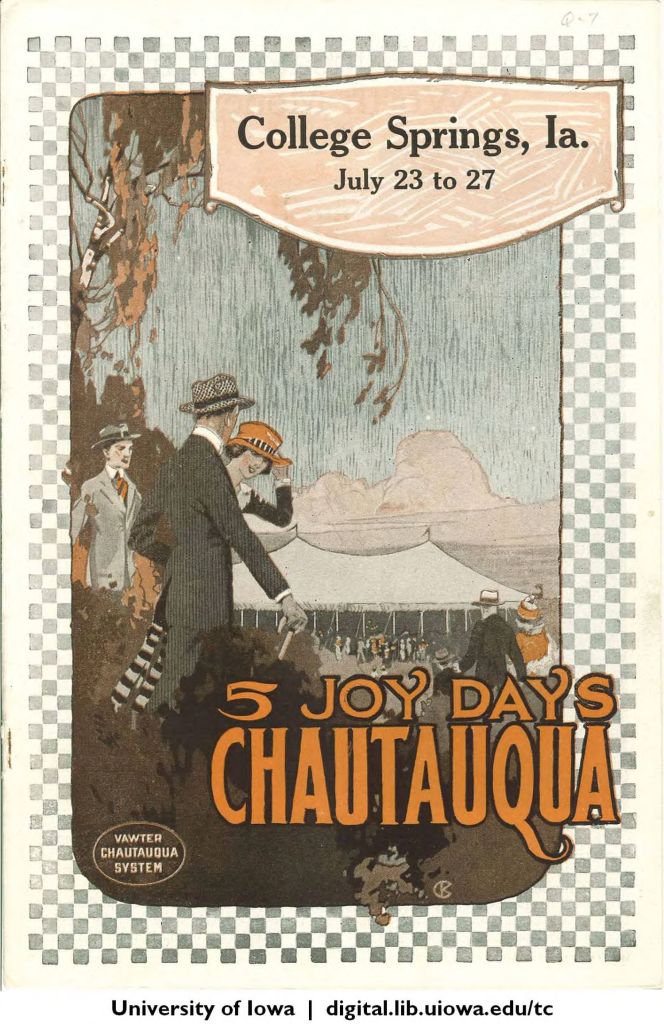
Opera was a touring tradition in the 19th century, with opera houses becoming permanently established in Chicago by 1910, and by 1923 it was permanent in San Francisco, California. It was important to Redpath Management to promote English speaking productions, and opera that was made available to middle Americans. This allowed many different regions to gain access to opera. It gained swiftly in nationwide popularity. It began in 1874 when Chautauquas assembled training programs for Christian education. It was meant to be inspirational and wholesome programming, founded by God’s word and work. In 1878, summer sessions opened up and the canvas tent became a fixture and associated with the Chautauquas. Communities began to organize independent programs, with reference that “education must be for the many, instead of the few.” By the 1880’s the Chautauquas expanded, and antebellum tours began across the area/ regions, where Ralph Waldo Emerson lectured as well.
After the Civil War, Lyceum models expanded across the north east and into the midwest. This movement grew in size to millions of members at one point, some would say it became a phenomenon. In 1904 independent Chautauquas sprouted up, and the Redpath agency began to put towns on a circuit. These circuits consecutively streamed shows, and because they were on a circuit, it cut down on the cost of traveling for patrons. In 1907, 33 independent Chautauquas joined the established circuit, and it continued to grow. In 1923 Redpath Management continued to be concerned with quantity, quality, and the distribution scheme of publicity. It was important for them to get it right, in a “natural way’’ that flowed smoothly. All the while maintaining the wholesome, positive effects, of its productions for the communities it served. Harry P. Harrison stated that, “rural Chautauquas offered programming in small towns, providing education and promised positive social effects from the continuing of adult education, and creative actions.”
The Circuit Bureau definitely concentrated efforts in the rural midwest. By 1915, preseason estimates were said to be that of 5 million people. This is amazing considering this was a time that did not have access to the electronic devices and social media we have today. People loved these events being offered to them. In 1920 there were 5,000 scheduled Chautauquas, and half of them took place in the midwest. At $2.00 a ticket, operatic selections were the standard fare in a Chautauqua show, especially light opera. Redpath “ran the gamut” with full costumes and lighting for productions. For the Redpath Management Company it was important for “Middle Americans” and not just the elite of society to enjoy opera.
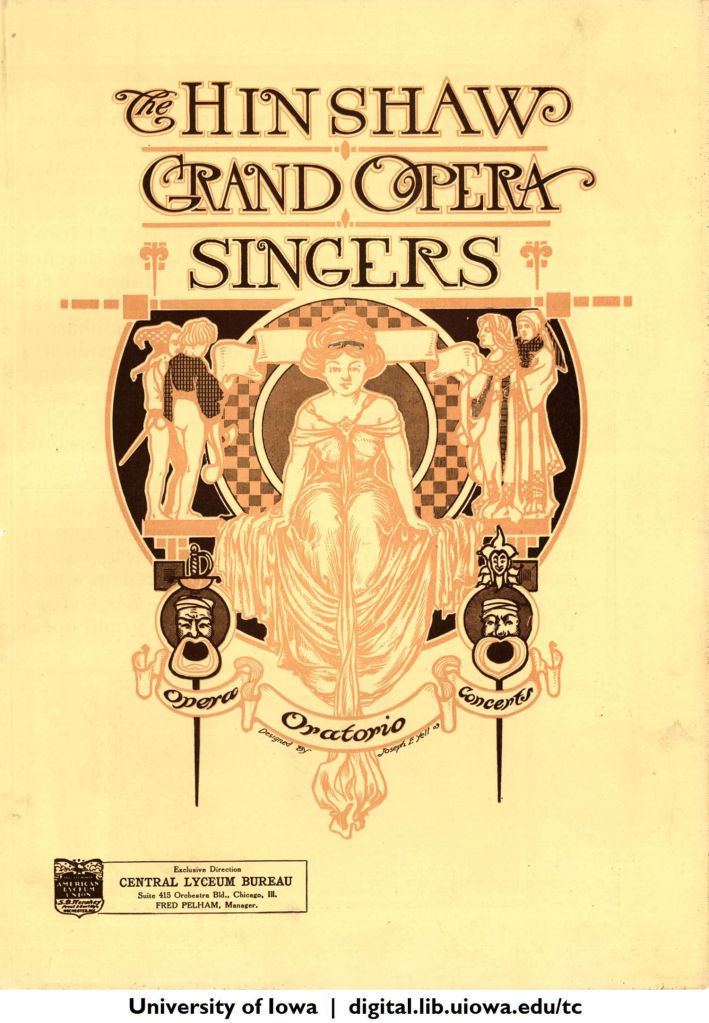
It was important to Henry Savage as well, that there was a season of opera in English, as Americans distrusted foreigners. Redpath wanted a middle ground for opera so that it could survive. Ernestine Schumann-Heink was an opera star who paid careful attention to Americanism, and promoted “Hear America First.” She said, “Americans won’t have to go to Europe to hear the opera, it will be provided in America.” Her reputation navigated to American demeanor and ideals. She was considered honest, loyal, and her demeanor made American audiences very comfortable. At the time her fee was $1000, by 1922 it was $2000 to $2500 per engagement. Today that would be approximately $40,000! May Valentine was hired by Harrison, and she worked for him from 1917-1925. Her “Bohemian Girl” performance was considered a light operatic fare. During this time, Redpath was also offering all kinds of music to include brass bands, tenor quartets, soprano soloists, and others. In keeping with this tradition of mixed performances, May Valentine offered that as well, with a staged Robin Hood performance. In 1925 with the Harry Harrison circuit, she had completed an incredible amount of touring across the United States. She said, “We have our own goal. We are not a protégé of an old world.”
Even though Ernestine and May were very popular and well received by audiences, by 1925 Chautauquas declined rapidly. Redpath closed in 1926, and by 1928 May Valentine closed her troupe. Redpath Management helped create American musical culture that allowed middle America to enjoy opera. It was a mission for them to give this musical style to everyone that they could.
As the lecture came to a close, the floor was opened up for questions. It was nice to see individuals interested in something that maybe they have never heard of. (Including me, I learned something new!) In an email exchange, I asked Professor Dan Hamner if I could quote his thoughts on the lecture. This is what he had to say, “I really love thinking about the cultural exchange between rural and urban and between high and low culture. So much innovation has happened in those exchanges.”
I have learned that the Chautauqua movement had a lasting effect, even though its numbers declined. It was an integral part of bringing culture and music to the United States. As Doctor Norling also stated in his lecture, “Some may find it interesting that Elvis Presley played a manager of a traveling Chautauqua group in a 1967 movie.” For me, that is an example that shows the impact that Chautauquas had on people. The “King” represented it in a movie! Today, only a small number of Chautauqua groups exist, but certainly they have an impressive legacy to share.
I highly recommend attending the Spring 2024 lectures sponsored by the GCC History Club. You will probably be pleasantly surprised by the knowledge you learn, like I was!
 The New Courier